

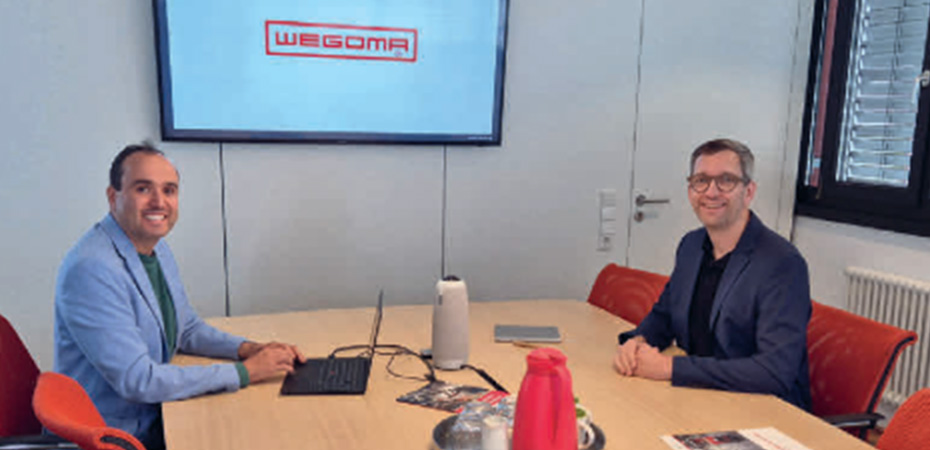
The combination of our strengths opens up new possibilities in window manufacturing
Since mid-2025, the organizational integration of Wegoma and Hecht AG into Hecht Wegoma GmbH has been officially completed. Since then, both companies have been working at the Besigheim site on integrated solutions for window manufacturing. The partners complement each other with different areas of expertise: Wegoma with many years of experience in plastics processing and custom machine engineering, and Hecht AG with competencies in control technology, software development, and automation. Michael Hettich, board member and owner of Hecht AG, and Holger Weiß, Sales Director of Hecht Wegoma GmbH and previously long-standing Managing Director of Wegoma, spoke about the background of the collaboration, current market requirements, and the next steps in development.
Could you briefly put the historical development of the Wegoma brand in German window manufacturing into context for our readers?
Holger Weiß: Wegoma was founded in 1970 and was particularly well-established internationally during the 1980s and 1990s. My father was active early on in markets that were not yet significant for many companies at the time, including the USA and China. In the early 1990s, subsidiaries were established in the USA and China. In 1993, a larger company headquarters with modern offices and expanded manufacturing facilities was built in Bretten. In 1997, a fire broke out at the plant, leading to a lengthy insurance and legal process that dragged on for several years. The delayed settlement by the insurance company ultimately led to insolvency. Nevertheless, customers continued to be supplied and activities were carried on in a reduced form. The US subsidiary, along with US distribution rights, was sold to Carlson as a result of the insolvency. Since 2023, the distribution rights have been back with Wegoma in Germany. Carlson ended production in the USA years ago and has also significantly scaled back its distribution activities. The plant in China still exists and continues to supply small machines.
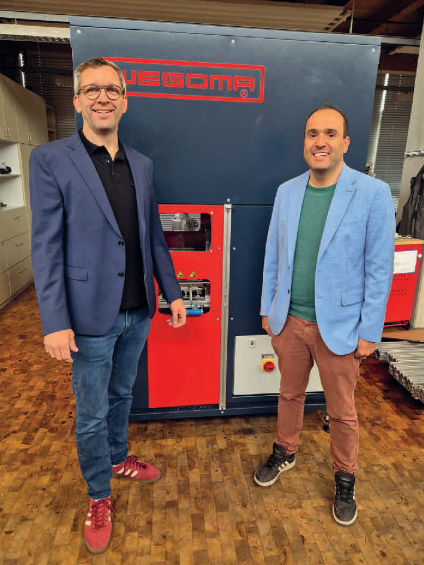
joint direction of Hecht Wegoma, with Hettich emphasizing:
“We do not develop solutions that are detached from the market.”
What significance did the brand have in the past for German window manufacturing?
Weiß: The Wegoma brand still enjoys great trust – both in Germany and internationally. At Fensterbau Frontale 2026 in Nuremberg, we clearly felt the emotional connection that many customers have maintained with Wegoma for decades. As part of our competition to find the oldest Wegoma machine still in operation, numerous visitors told us about systems that have been running reliably in their production for decades. Conversations like these show us the level of trust the brand has built up across generations.
Over the years, Wegoma has increasingly evolved from a classic supplier of complete production lines into a problem-solver and specialist for custom solutions. The brand has always been strongly positioned in the area of custom machine engineering, customer-specific solutions, and niche segments. Our aim was never solely to sell machines, but to support customers in the long term and develop individual solutions for their production. This philosophy still defines Wegoma today – and at the same time forms the foundation for the joint further development with Hecht.
Michael Hettich: The brand has always stood for technical solutions in the plastics sector and for numerous developments in window manufacturing. Examples include early automation solutions, combined welding and cleaning systems, or the automatic steel insertion. Technologically, Wegoma was ahead of its time in many areas and has shaped numerous developments in PVC window manufacturing. It is precisely this experience and know-how that we now want to combine with modern control technology, software development, and current market requirements.
What structural changes in the market environment have significantly influenced the brand’s position in recent years?
Hettich: The market has become significantly faster. Requirements for flexibility, automation, and process reliability are continuously increasing. At the same time, many window manufacturers are under economic pressure, which means that investment decisions today are made much more carefully than just a few years ago.
Added to this is the greatly increased variety of profiles and materials. Window manufacturers expect machine concepts that can handle different systems with as little retooling time as possible.
Weiß: At the same time, the development cycles of profile systems are shortening. Especially with PVC, hybrid, and aluminum solutions, the pressure to adapt on machine manufacturers is increasing. Our machines therefore need to be designed flexibly and be able to meet different requirements economically.
What strategic considerations led to the integration of Wegoma into the Hecht structure?
Hettich: Hecht AG had already been active in parts of the window manufacturing sector for years and had developed various solutions within the industry. However, we had previously operated more in the background and had not offered complete manufacturing solutions, but rather individual machines such as a cutting center for reinforcement steel, length stops, etc.
The collaboration with Wegoma was therefore an ideal complement. While Wegoma contributes classic mechanical engineering expertise, Hecht AG adds competencies in particular in data connectivity, control technology, and digital process integration. By combining these skills, more deeply integrated manufacturing solutions are intended to be created in the future.
The first contact was made in March 2025. From the very beginning, we had the feeling that not only competencies complemented each other, but also the mindset. Already at Fensterbau Frontale 2026, we were able to present a first joint product with the new glazing bead saw. Development started in November 2025 and was brought to a market-ready solution within just a few months. It motivates us enormously to develop solutions together that immediately create real added value for the customer. This adaptability is precisely what is decisive today.
Weiß: For us, it was also important that Wegoma remains family-owned. We deliberately did not want an external investor, but a long-term solution with sufficient room for maneuver. At the same time, it was important that the brand and the existing products would not disappear from the market.
What goals are you pursuing with this merger?
Weiß: We want to offer our customers more comprehensive solutions in the future – from individual machines to networked manufacturing solutions. At the same time, we want to bring mechanical engineering, control technology, and software development even closer together.
Beyond that, it is about shortening development times, responding more flexibly to customer requirements, and further expanding service. Our goal is to offer window manufacturers solutions that make their day-to-day work simpler, more economical, and future-proof.
Hettich: It is also crucial for us to continue developing the Wegoma brand sustainably while meaningfully combining the strengths of both companies. Added to this is Wegoma’s international network, which is also set to be leveraged more strongly in the future. Our goal is sustainable growth on an economically stable basis. Building on this, we want to continue driving internationalization forward.
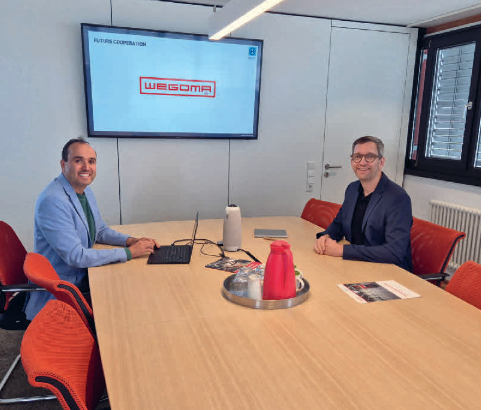
window manufacturing, as Weiß emphasizes: “Requirements in the market are continuously increasing – particularly in terms of operability and automation.”
What specific synergies result from this in the areas of development, production, and sales?
Hettich: A good example of this is the new glazing bead saw, which we presented live at Fensterbau Frontale. Development only began a few months before the trade fair. Despite this, we were able to present a fully functional product there. This demonstrates very clearly how closely the collaboration now works. Internally, there are no barriers whatsoever between the teams. We deliberately speak of “we,” even though both companies continue to exist independently.
Weiß: Wegoma’s production has been integrated at Hecht’s site. At the same time, sales, internal services, and development work very closely together. This gives us short communication paths and quick coordination. All Wegoma employees were welcomed very openly. This close collaboration is now felt throughout the entire company.
How will the interplay of the brands within the corporate structure be shaped in the future?
Hettich: Both brands will continue to exist independently in the market. External communications will also remain separate. At the same time, there is very close internal collaboration – particularly in the areas of development, production, and technology. Externally, they remain two independent brands, but internally we work with a shared technical foundation and a common strategic direction.
Which product areas will be the focus of further development in the future?
Hettich: We are currently focusing primarily on the further development of existing machines and solutions. The main focus is on automation, control technology, and extensions to the existing portfolio.
Following the glazing bead saw, we are currently working intensively on a sash stop center. In principle, however, we do not develop products “into the blue,” but consistently align ourselves with specific requirements from the market. Every further development is based on existing platforms and standard machines.
What challenges, customer requests, and market trends are you currently facing?
Weiß: The dominant topic is clearly the skilled labor shortage. Many companies are looking for solutions to automate processes more extensively and operate machines with as few personnel as possible.
At the same time, the variety of profiles and materials continues to grow. PVC-aluminum combinations in particular are becoming increasingly important. Our machines therefore need to be designed flexibly and be able to meet different requirements economically.
Development cycles for profile systems are also becoming ever shorter. This naturally increases the pressure on us as machine manufacturers. At the same time, customers today expect solutions that can cover as many variants and materials as possible, without requiring a completely new machine to be purchased every time.
Which customer segments are at the center of your market strategy?
Hettich: The focus remains on the classic window manufacturer – from medium-sized companies to larger production facilities. In general, we are now able to offer suitable solutions for a very wide range of company sizes. Our focus is on companies with production capacities of up to 120 window units per day.
What role does the German-speaking market play compared to the international orientation?
Weiß: Germany remains our most important market. At the same time, international orientation has traditionally been an important part of our corporate strategy. The USA in particular has developed very positively again in recent years.
The export share has been continuously growing. While around 70 percent of revenue was still generated in Germany in 2023, the split in 2025 was already approximately 50/50 between domestic and international business. Until 2018, Wegoma machines were distributed in the USA through the company Carlsen. Today, Wegoma operates there again under its own name.
Hettich: In addition to the DACH region and the USA, we also see markets such as Australia, South Korea, and India as very interesting in the long term.
Where do you currently see the greatest demands from the window manufacturing sector?
Hettich: In addition to the skilled labor shortage, we see heavy bureaucracy, lack of planning certainty, and declining building permits as major challenges. Many companies would invest, but currently have too little certainty for long-term decisions.
Greater planning certainty and faster approval procedures would help the entire construction industry and thereby also promote investment in modern manufacturing technologies.
Where are the key growth areas for the coming years?
Hettich: We see growth particularly in the areas of automation, intelligent control technology, and flexible manufacturing solutions. Custom solutions and individually adaptable machine concepts will also continue to gain in importance in the future.
Beyond that, we continue to see great potential in international business – particularly in the USA and, looking ahead, in markets such as India, South Korea, or Australia. Topics such as doors, lift-and-slide systems, and new material combinations also offer interesting development opportunities.
In which areas will you be making increased investments in the coming years?
Hettich: We will continue to expand the Besigheim site. The construction of an additional production hall is already in the preliminary planning stage. At the same time, we are investing specifically in engineering, software development, and the further expansion of our teams.
In the end, we do not build machines for machine halls. We develop solutions for people who produce windows every day. If we make their work simpler, safer, and more economical, then we have achieved our goal.
Mr. Hettich, Mr. Weiß, thank you very much for the conversation!